Should We Reimagine Loyalty for the Onchain Economy?
November 13, 2025
Loyalty programs are among the most valuable, and often least understood, assets in consumer industries. Airlines, hotels, retailers, and financial services firms have spent decades building vast ecosystems of points, perks, and paid memberships that now rival the scale of global payments networks and even the populations of large countries.
Today, as stablecoins, wallets, and smart contracts gain mainstream traction, a natural question emerges: what could loyalty look like if it were rebuilt on onchain infrastructure?
The Scale of Today’s Loyalty Economy
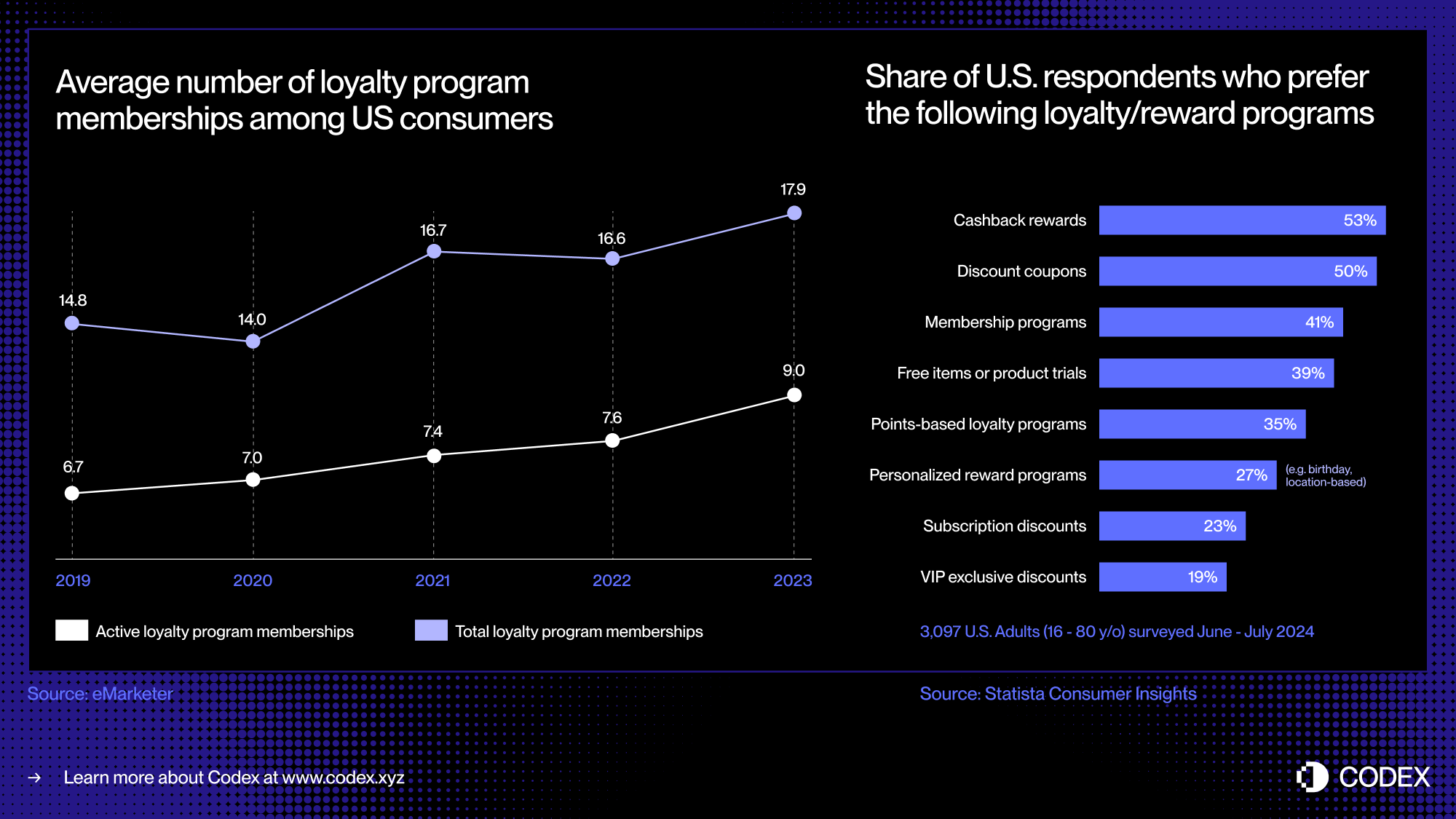
Loyalty programs have grown into some of the largest consumer networks in the world, bigger than the populations of many countries. What began as simple points-for-purchases schemes has evolved into global membership systems that shape how hundreds of millions of people travel, shop, and pay.
The world’s largest loyalty programs operate at national or even global population scale:
- Marriott Bonvoy and Hilton Honors each exceed 200 million members.
- Delta SkyMiles and American AAdvantage surpass 100 million members apiece.
- Amazon Prime, Costco, and Walmart+ reach a significant share of U.S. households, Amazon Prime is estimated at ~200 million global members.
- American Express card membership effectively functions as a loyalty ecosystem, with rewards, offers, and status tied to continued card usage.
And with this scale comes both opportunity and strain. These systems generate billions in profit, but they also rely on infrastructure built decades ago and are increasingly challenged by the demands of global interoperability, rising expectations for seamless digital experiences, and the operational burden required to keep them running.
Why Companies Build Loyalty Programs
Loyalty programs may look like marketing tools on the surface, but their real value lies in the economics they unlock. For airlines, hotel chains, and retail giants alike, loyalty is a high-margin revenue engine that drives predictable cash flows, strengthens customer lock-in, and monetizes entire partner ecosystems.
Far from being a simple 'points-for-purchases' mechanism, modern loyalty programs function as financial products, data platforms, and distribution channels, all rolled into one. This highlights a need for enterprise stablecoin solutions to modernize these complex systems.
- Direct revenue from selling points and miles: Airlines earn billions by issuing miles to banks and co-brand partners, turning loyalty currencies into a wholesale product line that can represent 40-50% of total profits.
- Recurring revenue from paid memberships: Subscription programs like Amazon Prime, Costco, and Walmart+ convert loyalty into predictable, high-margin recurring revenue while increasing customer dependence on the ecosystem.
- Higher lifetime value: Members buy more often, spend more per visit, and stay longer, creating a self-reinforcing revenue loop that outperforms non-members.
- Partner and ecosystem monetization: Large loyalty programs sell access to their customer base, generating incremental revenue from co-brand cards, travel partners, rental car networks, fintechs, and other third parties.
- Data monetization: Loyalty platforms capture rich behavioral and transactional data, enabling better segmentation, lower acquisition costs, and personalized marketing that directly improves revenue and retention.
Bringing loyalty onchain doesn’t replace these economics, it strengthens them. Tokenized rewards, stablecoin settlement, and wallet-based identity preserve the high-margin revenue model while delivering more transparency, lower costs, and richer interoperability for customers. The result is a loyalty system that keeps the economics of today’s programs but offers far greater value and a better overall experience.
The Case for an Onchain Loyalty
Existing loyalty programs are expensive and operationally complex, with airlines alone spending an estimated $15 billion a year on the technology and operations required to run them. Stablecoins and blockchains offer a way to rethink this entire architecture, replacing fragmented systems with shared ledgers, automated logic, and wallet-native user experiences.
This is where the onchain economy offers a fundamentally different design space:
- Loyalty points can become stablecoins: Instead of issuing proprietary, opaque “points,” companies can mint custom stablecoins, digital assets pegged either to fiat currency or to a predetermined redemption value.
The underlying economics don’t change: an airline can mint tokens, sell them to a bank, and the bank distributes them as rewards for new card accounts and card spend. Customers then use these tokens to purchase flights, upgrades, ancillaries, or transfer them to partners. This requires stablecoin liquidity solutions to ensure instant and reliable redemptions across the ecosystem.
- More value to share with customers: Onchain payment rails can also meaningfully enrich the economics of loyalty programs. Companies can bypass card networks and reduce payment costs, earn yield on stablecoin reserves, and benefit from instant, risk-free settlement.
These incremental gains create new economic headroom that can be recycled directly into richer customer incentives: higher earn rates, more flexible redemption, or new types of rewards altogether. - Wallets become the new loyalty form factor: The customer experience of loyalty today is fragmented across plastic cards, mobile apps, QR codes, login portals, and legacy databases. A wallet-first approach, leveraging real-time B2B stablecoin payments for partner settlement, collapses this fragmentation by storing everything the customer and merchant need directly in the wallet.
These can be represented as verifiable credentials or tokenized assets. The result is simpler, more portable identity and dramatically reduced operational overhead for merchants, who no longer need to maintain parallel systems just to identify loyal customers. - Operational simplicity through smart contracts: Behind the scenes, loyalty programs are operationally complex: custom ledgers, distributed partner integrations, reconciliation processes, fraud monitoring, breakage accounting, and highly customized earn/burn rules. Smart contracts can automate much of this infrastructure.
Onchain proofs streamline partnerships and reduce settlement disputes. Earning logic, status progression, expiration, and redemption can all be embedded directly into code. Stablecoin rails eliminate reconciliation friction. - Partner interoperability through shared, onchain identity: One of the biggest limitations of today’s loyalty programs is their closed, partner-specific architecture. Each program maintains its own customer identifiers, point balances, and benefit rules, creating friction whenever partners try to coordinate. An onchain model replaces this fragmentation with a shared, verifiable identity layer and a common ledger of benefits.
Customer credentials, status, entitlements, transaction history, can become portable, privacy-preserving assets that any authorized partner can verify. This allows loyalty benefits to flow seamlessly across airlines, hotels, retailers, and financial institutions without bespoke integrations.
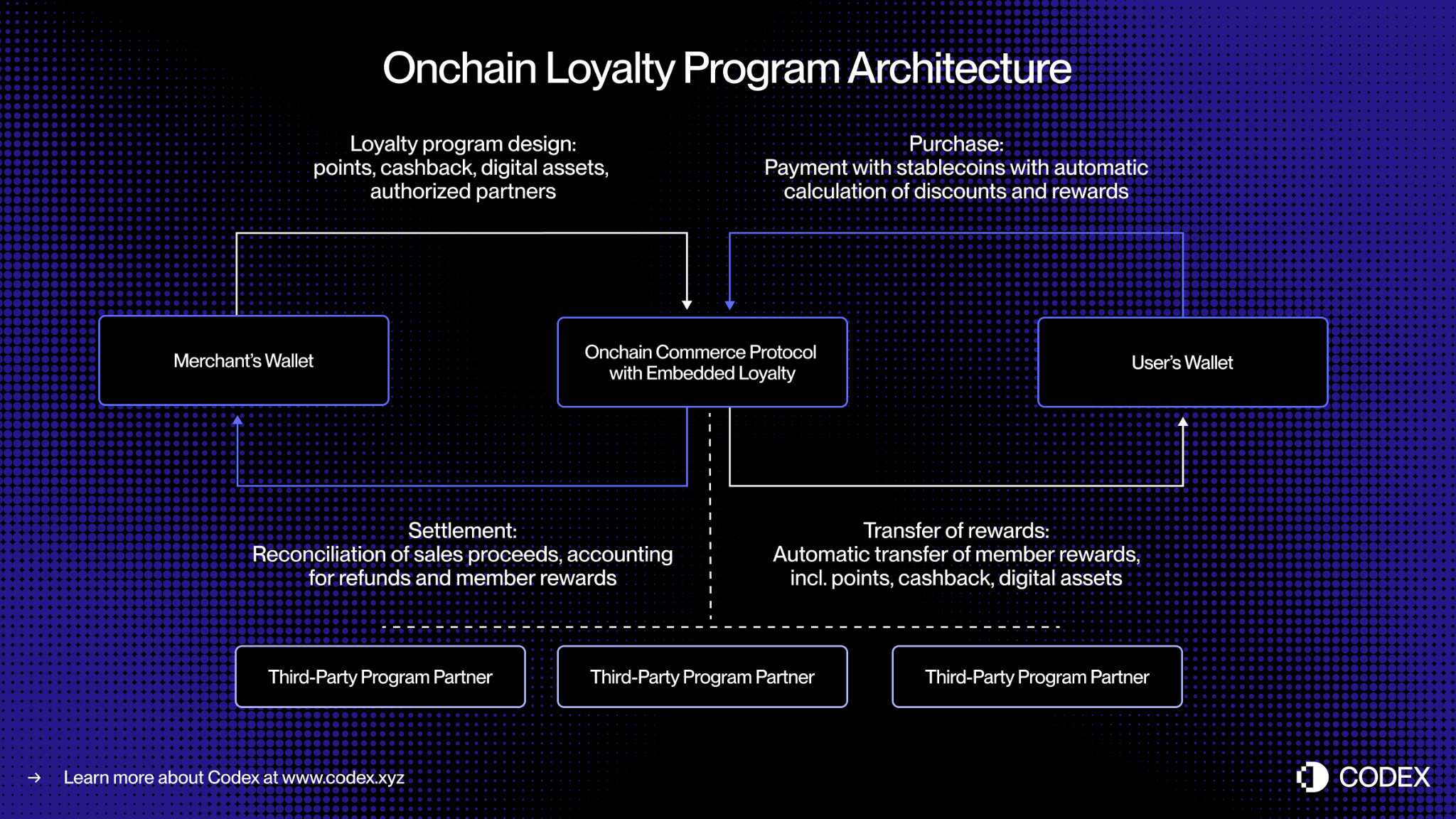
Taken together, these building blocks point to a fundamentally different loyalty architecture, one where rewards behave like money, status and benefits live in the wallet, and partners interoperate through shared, verifiable rails. The economic incentives that made loyalty programs so powerful in the first place don’t disappear in this model; they become easier to scale and more efficient to operate.
Toward a New Loyalty Infrastructure
Onchain loyalty shifts the center of gravity from fragmented, proprietary systems to an open and programmable foundation. Stablecoins remove friction from value transfer, smart contracts remove operational overhead, and shared identity removes integration pain across partners. For customers, this means loyalty that is more transparent, more flexible, and far easier to use. For companies, it means lower costs, richer data, and stronger ecosystem economics.
Loyalty programs have always been financial engines disguised as marketing. Bringing them onchain unlocks their next chapter, one where the economics strengthen, the user experience improves, and the industry finally gains an infrastructure suited to the scale it has already reached.
The question is no longer whether loyalty will move onchain, but how quickly companies will embrace the opportunity.